




Preparing for the Continued Evolution of Community Banking


This summer at DCG’s 42nd Annual Balance Sheet & Model Risk Management Conference, it was clear that technology and potential change in the funding landscape were themes that may play a significant role in the ongoing evolution of the community banking landscape.
I was encouraged by how many of DCG’s core principles and philosophies for managing risk and executing strategy can be applied even as these changes unfold.
From the Editor
“Don’t fear failure. Fear being in the exact same place next year as you are today.”
Michael Hyatt
It’s virtually impossible to watch a business television program, read a news publication, or scroll through a social media feed without being subjected to the notion of technology fundamentally changing life as we know it.
Whether it’s Agentic AI handling your financial needs or a robot traversing the side of a mountain at a breakneck pace, it’s clear that the way we live will be different.
And while it’s a bit intimidating to think of what all these changes might mean for our businesses, it’s more intimidating to feel like we’re going to be left behind!
The quote above summarizes this paradox perfectly. Don’t worry about today, just worry about getting better every day.
In this month’s Bulletin, DCG Managing Director Mike Mitchell writes about the influence of “change” via technological trends and the impacts on community financial institutions. He implores readers to prepare themselves for potential changes to the funding landscape.
Specifically, he lists four steps to “position your balance sheet today and into the future as the battle over money and deposits evolves.”
I highly recommend Mike’s thoughtful and anticipatory Bulletin for our readers. If nothing else, reading it will at least keep you out of the same place you were today!
Vinny Clevenger, Managing Director
Admittedly, while the latest round of technological developments (artificial intelligence, fintech, stablecoins, tokenized deposits) could be viewed as a threat, I prefer to embrace my colleague Justin Bakst’s view that technology will not replace us (or bankers in this case), but will simply accelerate the pace at which we solve problems and continue to improve our business models.
The core business model of banking can be described with a manufacturing analogy that DCG’s founder George Darling used to educate new board members with little or no banking experience. George was known for his affinity for high-quality pens. He would hold his pen high in the air and explain that the pen is the product being sold, and for Banks and Credit Unions that product is loans. The raw materials needed to produce the pen (loans) are the deposits.

In an industry that is constantly evolving, there is always room to question the sustainability, longevity, and relevance of the traditional banking model. Over the years, the staying power and relevance of products and strategies have been widely debated. When rates were near zero, many thought the Certificate of Deposit was phasing out. Mortgage strategies have come under new pressure as the sector is further commoditized by large fintechs. The “death of the branch” has been forecast for decades, but has yet to come to fruition.
Earlier in my career, I had my own concerns about the viability of community banking. However, after seeing this industry in action for 20 years, I have more confidence than ever that no one can automate or commoditize the community lending (small business, rural agriculture, local consumer) that drives the very heart of our economy.
Technology can certainly reduce friction and enhance the process, but it cannot substitute the personal relationships and local knowledge needed to make it all work. In other words, there will always be a demand for “pens” (loans), and community institutions will continue to play a key role in providing the supply.
The question then shifts to, How could the source of raw materials (deposits) change over time? In one particularly timely conference session, “Unlocking Future Financial Products with Tokenized Deposits and Stablecoins”, Vantage Bank’s Shawn Main gave a crash course on the latest digital developments.
The fundamental question on the minds of bankers is, Who will win the battle of where money lives? And importantly, what will happen to the cost and availability of traditional deposits? With a recent flurry of Fintechs applying for National Trust Bank charters, the battle over money placement and movement is well underway. While a National Trust Bank charter does not allow these companies to make traditional commercial loans or accept FDIC insured retail deposits, it does permit custody of digital assets, stablecoin reserve management, payment settlements, and fiduciary services.
Will the next step be for these Fintechs to partner with larger commercial banks, or eventually apply to convert to a full bank charter themselves?
Who will win the battle of where money lives? What will happen to the cost and availability of traditional deposits? While no one can predict the future, we can fall back on time-tested philosophies and approaches to prepare for and navigate through these changes.
Here are four things institutions can do to help favorably position balance sheets today and into the future as the battle over money and deposits evolves.
1) Stay up to date on the latest technology and regulations.
Understand the key differences between stablecoin and tokenized deposits. Get familiar with the battle over paying interest or offering rewards on stablecoins and the final language in the Clarity Act. Understand what products and services customers currently use beyond your institution. Do you view P2P money transfer apps as a competitor or a complement to your customers’ financial services? What about online stock investment apps? Will tokenized deposits be offered through a network approach or at the individual institution? How will payment rails evolve, and who will be the providers or gatekeepers? You may not have answers to any of these questions today, but having someone on your team take ownership of monitoring, understanding, and reporting these issues as they develop may be critical in your ability to adapt, adopt, and react.
2) Understand your existing deposit mix.
DCG just announced the launch of the Deposit Retention IndexTM, which tracks the retention of relationship-level deposit balances and whether they are expanding or contracting on an annualized basis. What’s driving this behavior at your institution? Inflation and interest rates? Or does it have to do with an evolution in customer demographics, preferences, and behavior? There is a clear use case for stablecoin as an international exchange of value. It could significantly reduce the time and cost of moving money across borders. Would your institution have customers at risk today if you were unable to offer this product? Map out your customer mix in terms of age, use of products, balances, and more to understand your potential risk or opportunity as deposit products and digital currency evolve.
3) Get comfortable with wholesale funding.
Regardless of whether you use wholesale as part of your overall funding strategy, having a diversification of potential funding sources is always a good idea. Of the following, how many does your institution have access to?
The Federal Home Loan Bank (FHLB)
The Federal Reserve (FRB)
Brokered Deposits
National Deposits
Fed Funds Purchased from Corresponding Banks/CUs
Do you monitor the cost of each relative to business and consumer deposit growth strategies (especially if conversion/cannibalization is a risk)? Have you tested these sources, and have you memorialized the process so that you can access these funds if and when appropriate?
4) Unlock the liquidity within your asset base.
In DCG’s opinion, there is no such thing as too much off balance sheet liquidity, meaning the more access to funding you have, the better. Institutions can pledge assets that they can then, in turn, borrow against. Collateral-based liquidity availability exists at both the FHLB and the FRB. By pledging collateral, these liquidity resources offer an extra level of dependability, especially in times of stress. What is the percentage of loan-based borrowings you could access relative to total loans? DCG has observed a wide range when it comes to total loan-based borrowing capacity as a percentage of the loan portfolio. The impact on liquidity management can be substantial if this number is at one end of the extreme or the other. What is the right number? In this case, more is better, given there is no cost beyond the work of reviewing and submitting the collateral. Annually, institutions should thoroughly review the loan collateral pledging process to maximize qualifying loans. Pledge loans to both the FHLB and the FRB. As part of a strategy to maximize borrowing capacity, understand the difference in collateral acceptance and haircuts between the two. Move collateral from one to the other, understanding the timing and logistics to be operationally prepared.
There is no doubt that new and evolving technology and competition pose a threat to the traditional deposit landscape; however, history would suggest this is continued evolution rather than a revolution. Parallels can be drawn to the introduction of Money Market Mutual funds in the 1970s, which currently measure $7.8 trillion. While that is a piece of the money pie, it is worth acknowledging that total commercial bank deposits measure roughly $19 trillion and have increased steadily for the last 50 years.
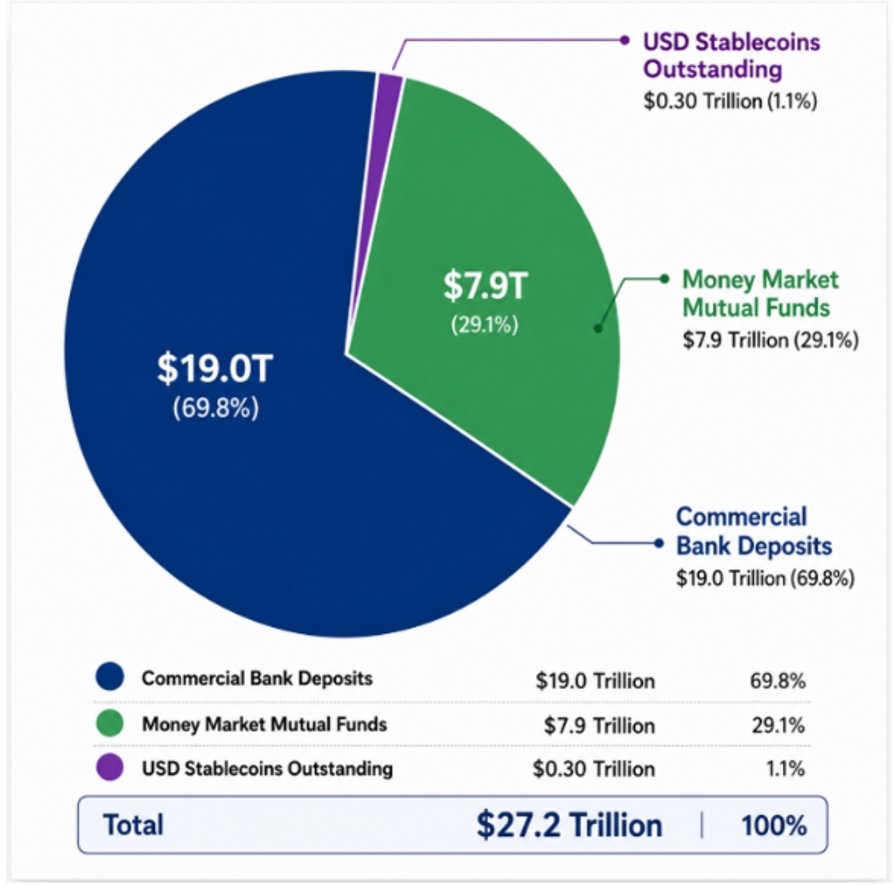
Sources: Federal Reserve H.8 (Commercial Bank Deposits, latest weekly release), Investment Company Institute (Money Market Mutual Fund Assets, week ended July 15, 2026), and DeFiLlama Stablecoin Dashboard (USD stablecoins outstanding, July 2026). Values rounded to the nearest $0.1 trillion. Figures are approximate and represent outstanding balances as of July 2026. Stablecoins represent globally outstanding USD-denominated stablecoins rather than balances held exclusively by U.S. residents.
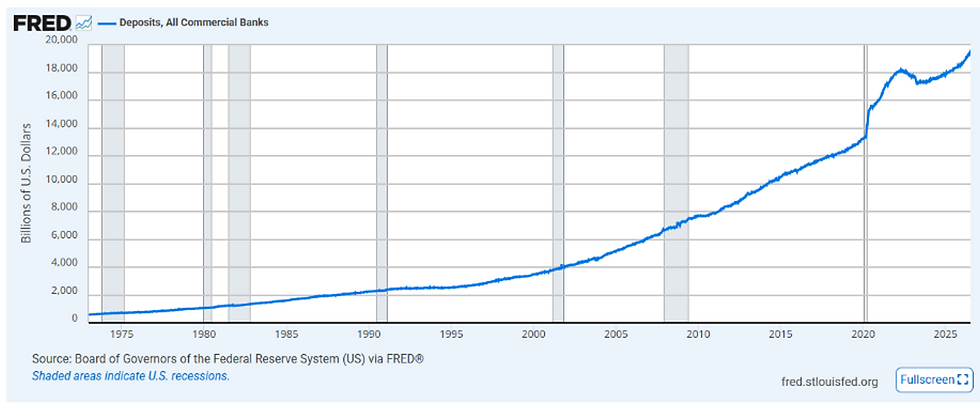
Source: Board of Governors of the Federal Reserve System via FRED®, data as of 7/17/2026.
The business of banking will continue to change. Stay informed, do your homework on your existing depositors, diversify your funding options, and maximize the liquidity within your asset base to be well positioned for continued evolution.
For more insights from Darling Consulting Group, click here.
Mike Mitchell is a Managing Director at Darling Consulting Group, where he leverages his passion for the asset liability management (ALM) process to maximize strategic effectiveness, manage risk and optimize income. Advising executive teams for institutions all over the country, he provides tailored, thought leading solutions in an ever changing economic and regulatory environment.
Mike has been with DCG since 2006 and is a graduate of University of New Hampshire with a degree in finance. When not talking ALM, Mike can be found hiking, biking, and skiing in the mountains of New Hampshire with his family.
© 2026 Darling Consulting Group, Inc.


