




Deposits360°® Monthly Industry Review


This month’s Review highlights emerging deposit trends and signals in DCG's Deposits360° Cross-Institution Analytics database and deposit pricing/volume models.
Time Deposits Tipping Point
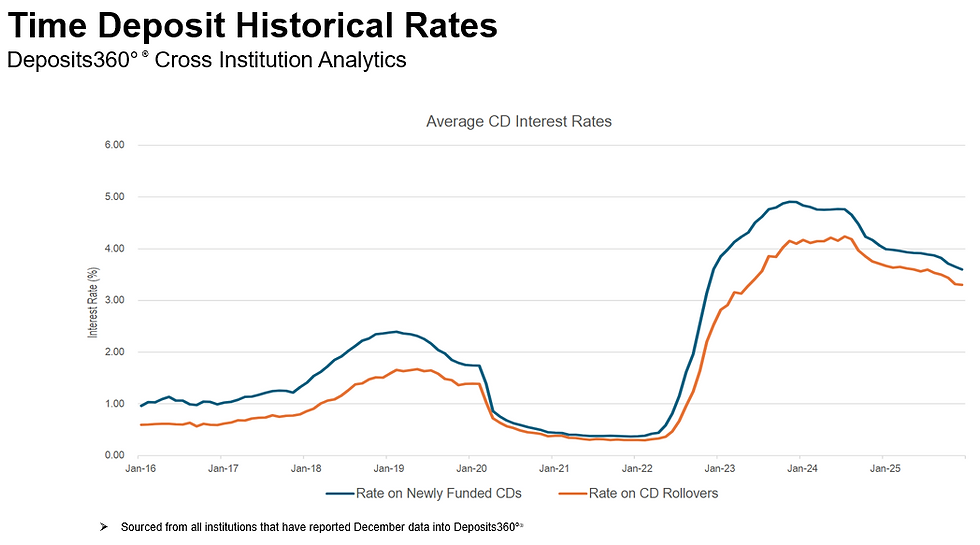
Look out below! The average rate on newly funded CDs has declined by more than 130bp since the Fed began cutting its policy rate in Q3 2024. Rates on CD rollovers have also declined, albeit from a lower starting point. Now that Fed has turned the page on 2025 – a year that saw 75bp of rate cuts – banks and credit unions are wrestling with the tradeoffs that come with executing on further rate reductions in the CD book.
Source: Darling Consulting Group Deposits360°®
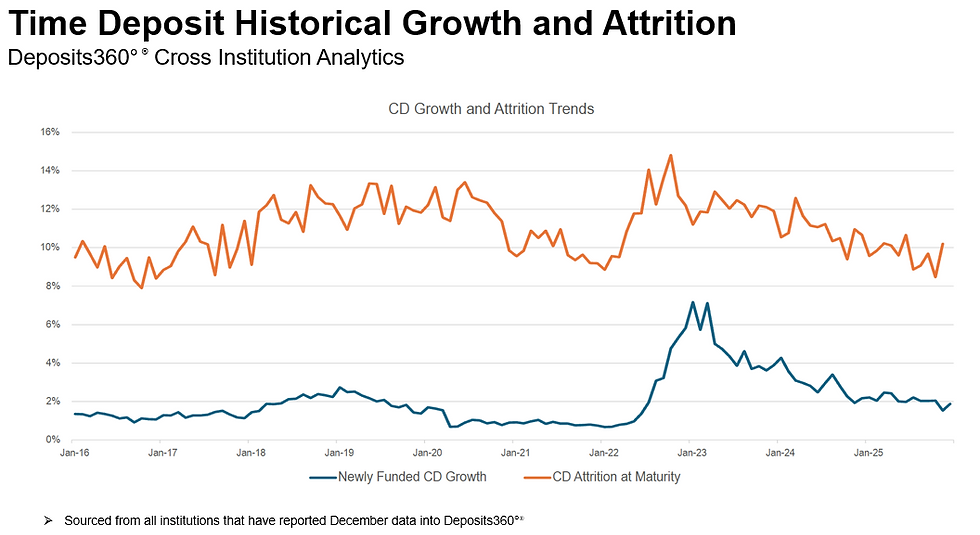
There is no doubt that institutions have benefited from CD pricing reductions, and many are projecting continued cost savings as upcoming maturities roll into new terms in 2026. However, DCG’s Cross-Institution dataset shows that institutions may have trouble maintaining the pace of new CD growth that materialized over the last three years. Growth and attrition trends have been steadily declining since 2023.
Source: Darling Consulting Group Deposits360°®
For institutions that have implemented aggressive CD rate cuts, the resulting decline in CD growth has been even more pronounced than what the chart above illustrates. In fact, DCG has seen examples where rate cuts have led to increased attrition and meaningful outflow of CD balances. In some cases, institutions were forced to back-track and increase their pricing again to stem the outflow.
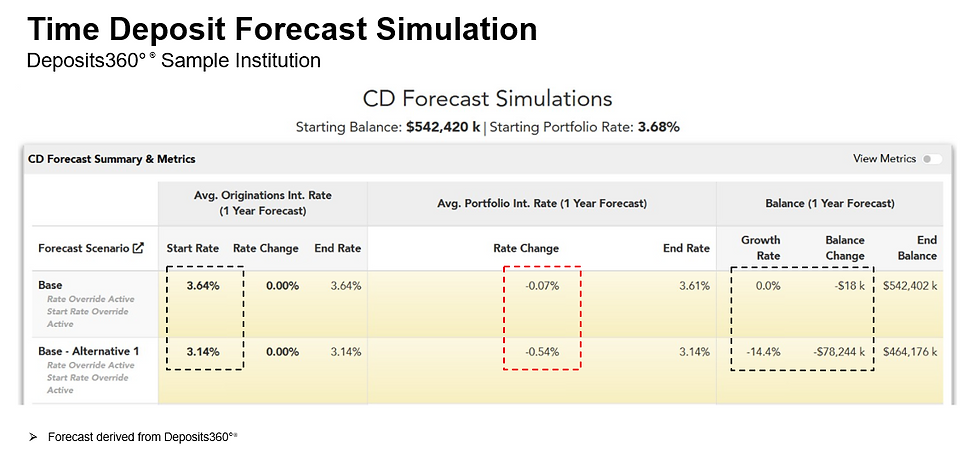
Deposits360° users can simulate CD pricing decisions and examine the forecasted impact on balances to find the best tradeoff between cost savings and liquidity before they execute. For example, the following example shows that a 50bp decrease in CD pricing at one institution is expected to result in a 14% balance decrease over the next 12 months.
Source: Darling Consulting Group Deposits360°®
In this example, the institution decided that the cost savings associated with the rate reduction would more than offset the liquidity impact of CD runoff, particularly since it expected to grow its non-maturity deposit base over the course of the year.
Talking About My Generation
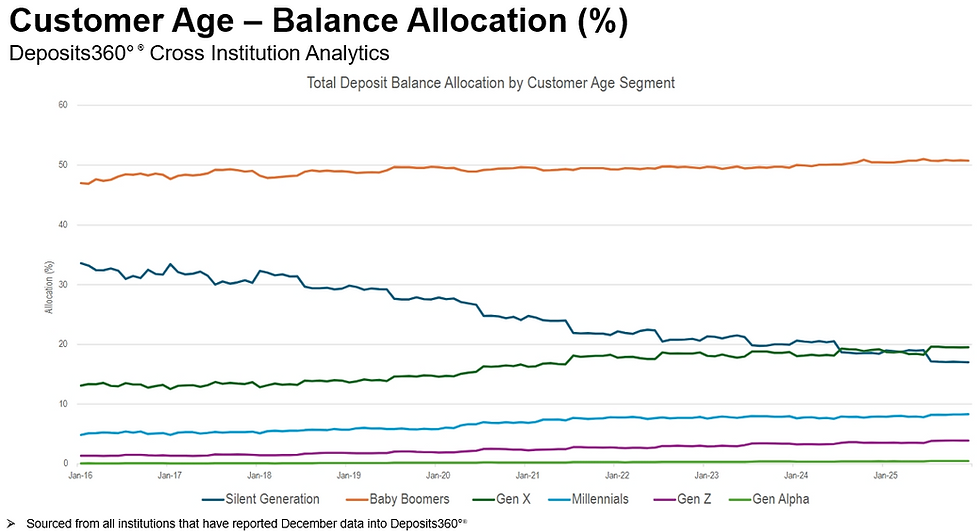
As institutions think about building and growing deposit relationships, conversations often focus on increasing the number of products and/or services that each customer has, and this metric is critical for increasing deposit stickiness. However, deposit data often has a wealth of other valuable information that can be sorted and segmented to parse out useful trends and help target cohorts of depositors with marketing initiatives. For example, consider trends based on customer age. In this analysis, we have divided depositors by generation.
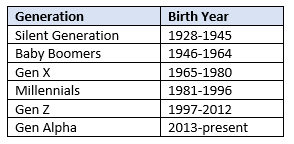
Over the past decade, deposit allocations have begun shifting out of older cohorts toward younger generations. The Silent Generation’s share fell sharply, dropping from the low-30% range in 2016 to about 17% by 2025, reflecting natural drawdowns and wealth transfer. Baby Boomers have remained the dominant group throughout, but their share has edged up only modestly and has largely plateaued around 50%, suggesting stability rather than growth. The biggest gains came from Gen X and Millennials: Gen X rose from roughly 13% to nearly 20%, while Millennials almost doubled from under 5% to more than 8%, signaling their transition into peak earning and saving years.
Source: Darling Consulting Group Deposits360°®
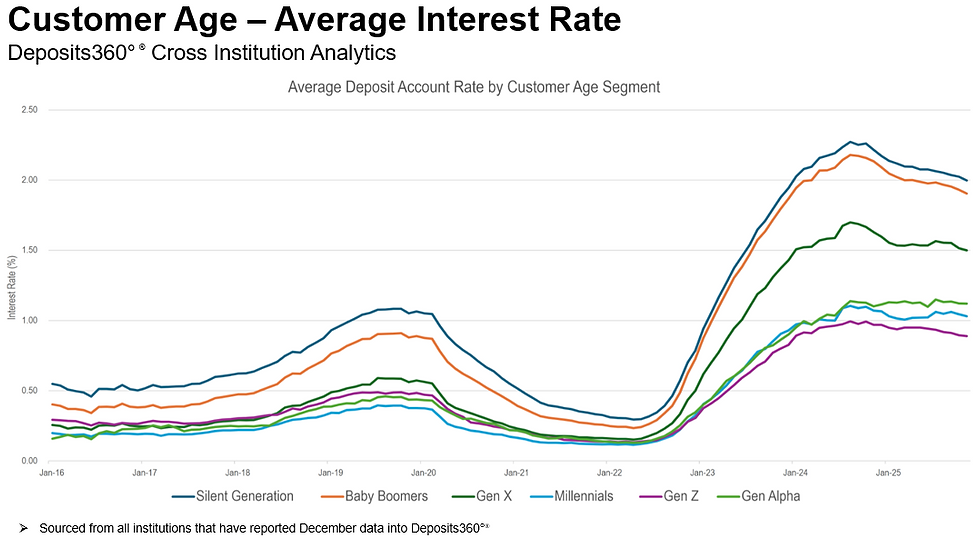
When we consider average rates being paid to each generation, there seems to be a stable hierarchy, with the Silent Generation and Baby Boomers earning the highest rates. In fact, as deposit rates repriced higher in the 2022-2024 tightening cycle, older cohorts benefited disproportionately. Going forward, if rates continue to ease, DCG projects the same hierarchy to persist. Deposits may be shifting younger, but pricing and product advantages remain concentrated among older customers.
Source: Darling Consulting Group Deposits360°®
As the depositor base evolves, institutions will need to adapt how they engage, price, and serve each generation. We encourage teams to dig deeper into the customer cohorts that matter most to your strategy.
Darling Consulting Group will continue to monitor the Cross-Institution data in Deposits360° and bring you insights to help you manage your deposit base.
To learn more about how DCG's Cross-Institution Analytics can help drive strategic decision-making, click here.
© 2026 Darling Consulting Group, Inc.


